




A few days ago, when reporters asked whether Iran’s map would look the same after the war, Donald Trump replied: “I can’t tell you that… Probably not.”At the same time, he has framed recent joint U.S.–Israeli strikes partly as an effort to liberate the Iranian population from its government, repeatedly calling on Iranians in recent months to rise up against the Islamic Republic of Iran.This raises an important question: what do Iranians themselves want?Would they accept the promise of “liberation” if it came at the cost of their country’s territorial integrity?
No to Territorial Division
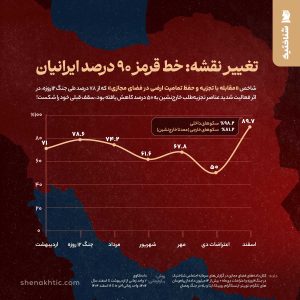
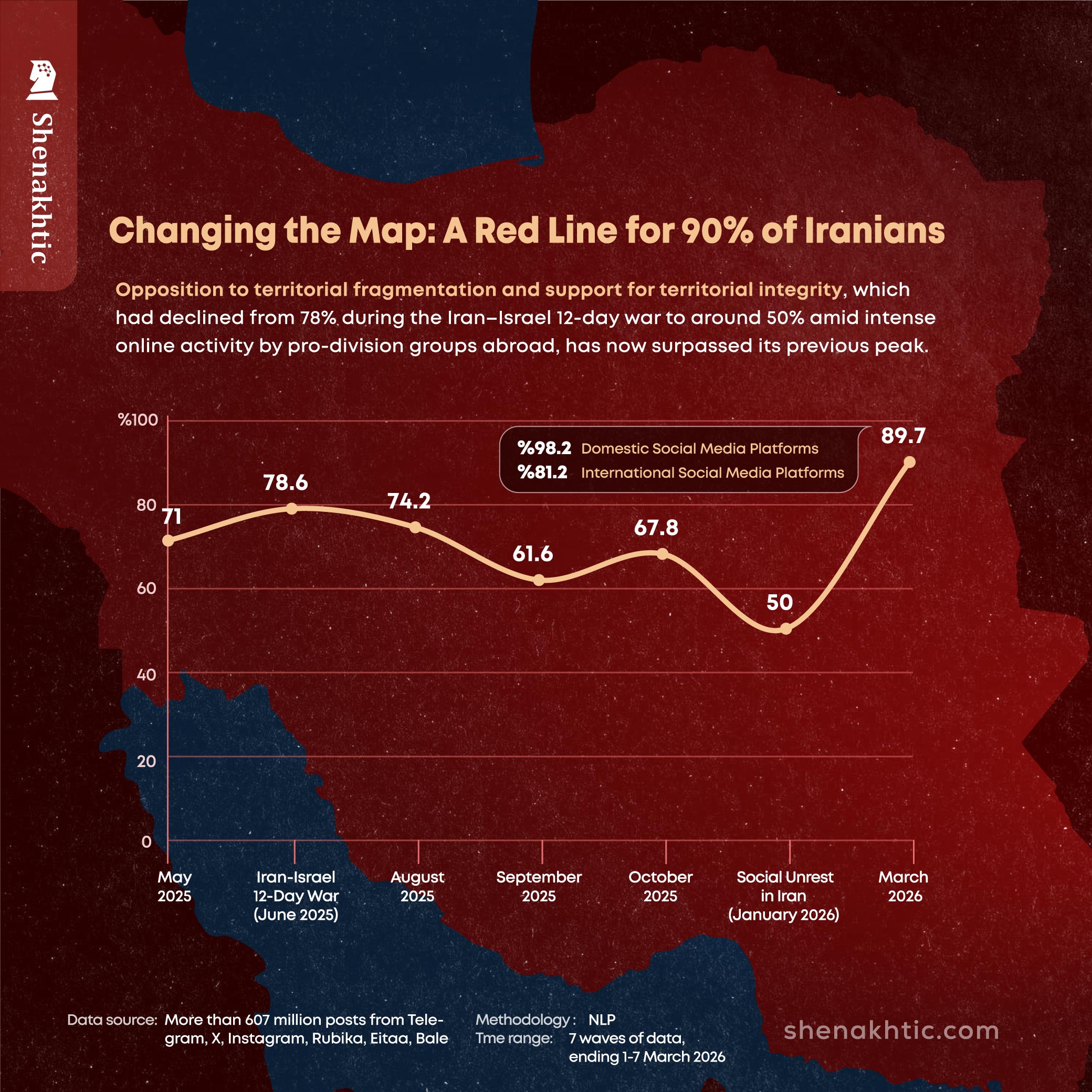
Large-scale analysis of social media data shows strong support among Iranian online users for the country’s territorial integrity in the face of foreign threats.An analysis of large-scale social media data collected over the past 10 months indicates that Iranians become significantly more united during wartime, expressing strong support for maintaining the country’s territorial integrity.Support for territorial integrity peaks during periods of active conflict.During the Iran–Israel 12 Day War (June 2025), opposition to separatism and support for national unity reached 78.6%.After the conflict ended, this trend gradually declined. At the same time, pro-division groups outside Iran increased their online activity, producing a large volume of content against territorial integrity during December 2025–January 2026.However, with the escalation of the current war, the index has risen sharply again—reaching 89.7% support for territorial integrity.
A Small Minority Supporting Separation — Mostly Outside Iran
The findings show that during the current conflict:
• 98.2% of messages on domestic Iranian platforms
support territorial integrity and oppose separatism:
• 81.2% of messages on international platforms express the same view
Because international internet access within Iran has been heavily disrupted during the war, most activity on global platforms appears to originate from Iranians living abroad. This suggests that support for territorial division largely comes from outside the country’s borders.
War and the Temporary Bridging of Internal Divisions
Social media trends over the past 10 months suggest that external threats strengthen national identity among Iranians.Under the pressure of bombardment and war, online discourse shows a surge in expressions of shared national identity and unity. As in the 2025 Iran–Israel war, the external crisis once again acts as a form of “national glue,” temporarily bridging internal political and social divisions.Whether this temporary cohesion persists after the war remains an open question.
Data Sources and Methodology
This study analyzes large-scale social media data collected between May 2025 and March 2026 from both domestic and international online platforms.Because international internet access within Iran has been significantly restricted during wartime, posts on global platforms in wartime episodes are more likely to reflect the views of the Iranian diaspora, while domestic platforms primarily capture online discourse from users inside Iran.