



The “Post-War Iran” Outlook in Major Western Analytical Media: Transitioning from a Regional Actor to a Global Power via Control of the Strait of Hormuz
The prevailing image of “Post-War Iran” in leading Western media focuses less on the country’s collapse or removal and more on its enduring importance within the regional order—and, notably, a relative elevation of its global standing.
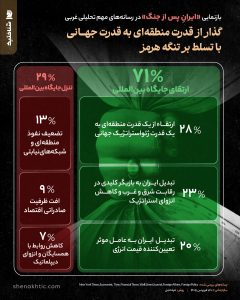
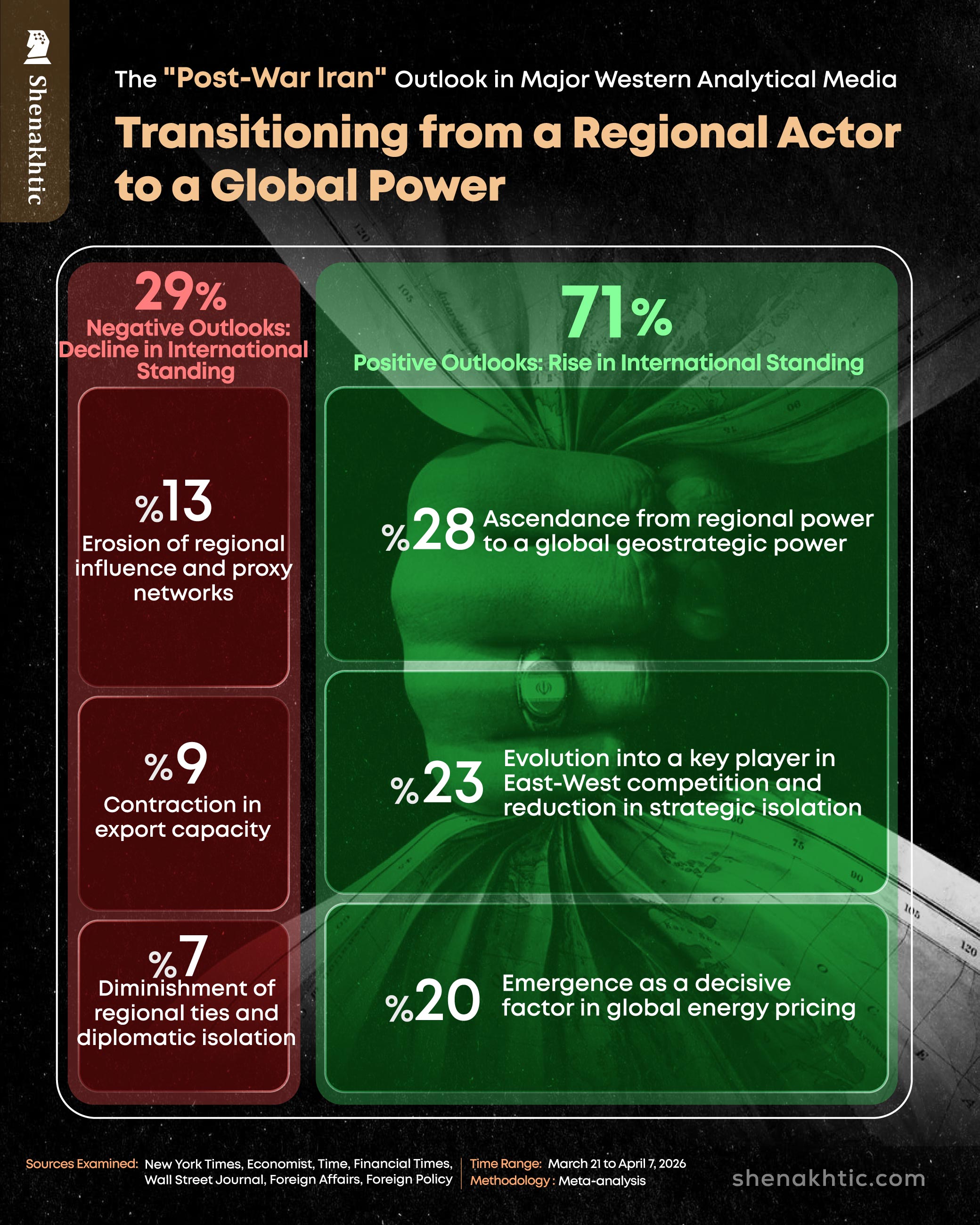
Content analysis reveals that approximately 71% of the analytical discourse regarding post-war Iran focuses on different aspects of “International Ascendance,” while 29% pertains to “International Decline.” This ratio clearly indicates that, in the eyes of these media outlets, the conflict does not necessarily lead to Iran’s marginalization; rather, it may result in an increase in its geopolitical weight across several key sectors.
I. From Regional Actor to Global Geostrategic Power
Among the arguments supporting Iran’s rising international stature, the most significant theme is the transition from a regional power to a global geostrategic power, accounting for 28% of the total discourse. This suggests that the analyzed media no longer view Iran merely as a Middle Eastern actor, but as a critical player influencing global energy security, international trade, and the global balance of power through its role in the Strait of Hormuz. In this framework, the “post-war” moment is seen as the catalyst for Iran to leverage its geographic position and deterrent capabilities to become a trans-regional player.
II. Transcending “Strategic Solitude”
The second major pillar of ascendance is Iran’s evolution into a key player in East-West competition and the subsequent reduction of its diplomatic isolation. In this context, post-war Iran is depicted as a “Maritime Veto Power.” Analysts suggest that by controlling the Strait of Hormuz and regulating the passage of specific vessels, Iran transforms the strait from a purely international waterway into a “regulated sphere of influence.” Here, Iran does not merely threaten; it politicizes the rules of transit. Consequently, Iran emerges from strategic solitude, with even critical media outlets acknowledging it as a decisive element in the new global equation.
III. A Structural Factor in Global Energy Pricing
The third aspect of Iran’s rising status is its role as a decisive factor in global energy markets. The focus on the Strait of Hormuz and potential price shocks indicates that, in the view of these outlets, Iran’s geo-economic position allows it to exert structural pressure on world markets. Thus, even if Iran faces domestic economic constraints, it retains the capacity to impact the global economy fundamentally.
The Arguments for Decline: The Path to Diminished Standing
While the majority of analyses anticipate an elevation of status, some analysts—operating on the premise of successful offensive operations against Iran—predict a decline.
• Erosion of Influence (13%): The primary negative factor is the weakening of regional influence and proxy networks.
• Economic Contraction (9%): A decline in export capacity and economic output.
• Diplomatic Attrition (7%): A reduction in relations with neighbors and increased isolation.
Notably, even within this negative subset, the dominant narrative is not one of “removal,” but rather of Iran becoming a high-cost, yet un-eliminable actor whose power sources have been partially eroded.
Sources Examined: New York Times, Economist, Time, Financial Times, Wall Street Journal, Foreign Affairs, Foreign Policy.
Methodology: Meta-analysis
Time Range: March 21 – April 7, 2026