



Framing the Meaning of the Ceasefire in the Media: Who Was Seen as Backing Down — Iran or the United States?
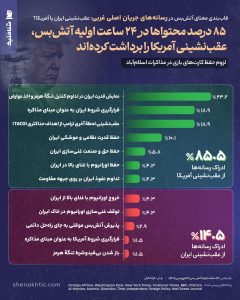
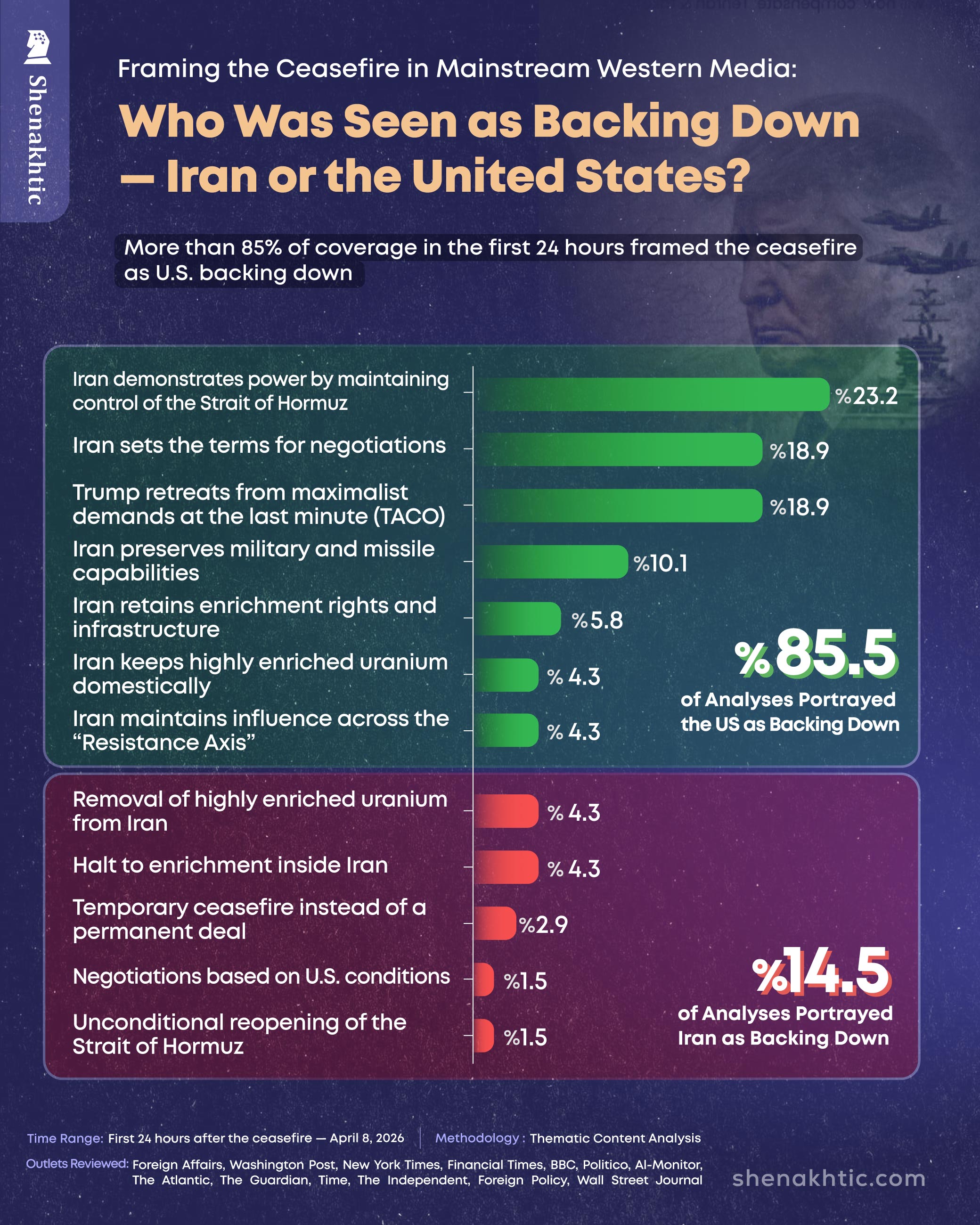
In the first hours after the ceasefire between Iran and the United States was announced, a dominant narrative quickly emerged in mainstream Western media. In 85.5% of published analyses, the development was interpreted not as a balanced compromise but as a sign of U.S. retreat, while only 14.5% concluded that Iran had backed down. This meaningful gap reflects the formation of a dominant narrative in the Western media space — one grounded in a set of specific developments and observable behaviors.
U.S. Concessions Identified in Media Analyses
Among the arguments reinforcing the perception of U.S. retreat, Iran’s demonstration of power through continued control of the Strait of Hormuz and the imposition of transit costs ranked first, at 23.2%. This was followed by Iran’s conditions forming the basis of negotiations and Trump’s last-minute retreat from maximalist goals, each at 18.9%, both playing a decisive role in shaping this narrative.
Preservation of Iran’s military and missile capabilities accounted for 10.1%, while retention of enrichment rights and infrastructure made up 5.8%, further reinforcing this interpretation. Even factors such as continued Iranian regional influence and the continued presence of highly enriched uranium inside Iran, each at 4.3%, were cited as signs that the United States had failed to achieve its objectives.
Iranian Concessions Identified in Media Analyses
By contrast, arguments suggesting Iranian retreat were more scattered and less prominent. Removal of highly enriched uranium and halting enrichment on Iranian soil each accounted for 4.3%, representing the most cited elements of this narrative. Acceptance of a temporary ceasefire appeared in 2.9% of coverage. Items such as U.S. conditions forming the basis of negotiations and the unconditional reopening of the Strait of Hormuz, each at 1.5%, further indicate that this narrative lacked coherence and persuasive strength.
Will Iran Preserve Its Leverage Until an Agreement?
With more than four-fifths of media narratives currently favoring Iran, the central challenge now is whether Iran can preserve this leverage in the upcoming Pakistan-mediated negotiations in Islamabad. Experience suggests that perceptual advantage only translates into tangible gains if the side holding it manages to retain its leverage at the negotiating table.
If Iran seeks to convert this moment into a lasting outcome, it must preserve the very elements highlighted in these analyses — from control of the Strait of Hormuz (23.2%), to setting the framework for negotiation terms (18.9%), to maintaining military capabilities (10.1%) — as its key bargaining chips.
In short, the battle of narratives may have tilted in Iran’s favor — but whether this advantage endures depends on Iran’s ability to preserve and deploy its leverage at the Islamabad negotiating table.
Outlets Reviewed: Foreign Affairs, Washington Post, New York Times, Financial Times, BBC, Politico, Al-Monitor, The Atlantic, The Guardian, Time, The Independent, Foreign Policy, Wall Street Journal
Methodology: Thematic Content Analysis
Time Range: First 24 hours after the ceasefire — April 8, 2026