



A large-scale analysis of X data shows how the US-Israeli war against Iran quickly spilled into everyday American life. Nowhere was this more visible than in reactions to developments in the Strait of Hormuz, where each new escalation was rapidly reflected in public anxiety over gasoline prices.
Pre-conflict trends
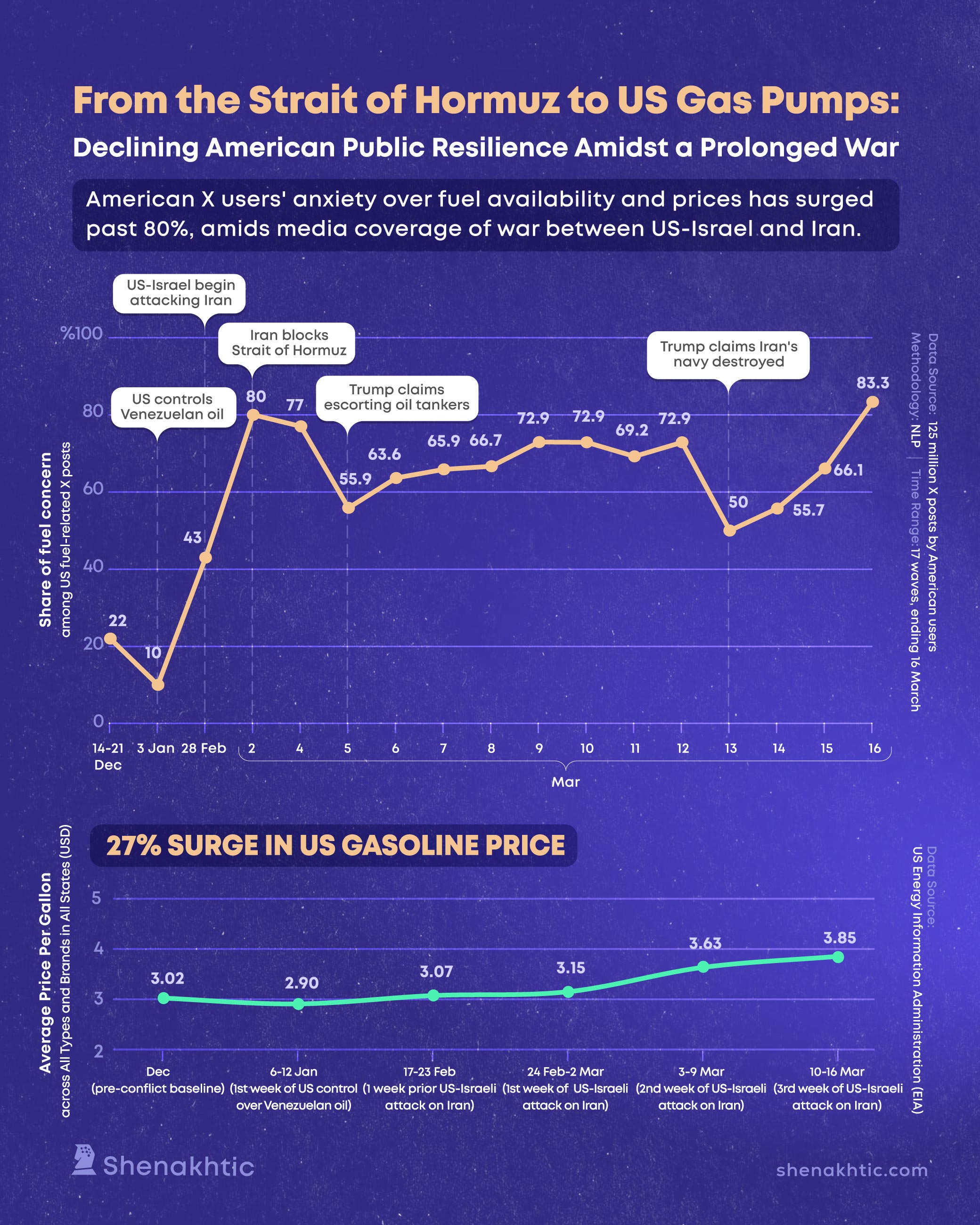
US gasoline prices had been falling throughout December 2025, dropping from $3.02 to $2.90 per gallon. That decline was expected to continue, especially after the capture of Venezuela’s president and the tightening of US control over Venezuelan oil supplies. But social unrest in Iran during January, followed by Trump’s pledge to support the rioters, raised expectations of a possible military strike. Anticipation of such an intervention—and its likely effect on energy markets—halted the downward trend and pushed fuel prices upward. As a result, gasoline prices began rising steadily nearly two months before the US-Israeli war on Iran began.
The Hormuz effect
In the first days after Iran blocked the Strait of Hormuz in response to the US-Israeli assault, public concern in the United States surged to an unusually high level. On March 3, more than 80% of energy-related posts on X referred directly to fears of rising gasoline prices. This spike was driven by early reports of naval clashes in the Persian Gulf and the possibility of serious disruptions to oil exports, which quickly inflamed the U.S. media narrative. The following day, anxiety remained high, with about 77% of energy-related discussion on X still focused on fuel prices.On March 3, concern eased to around 56%, after Trump claimed that oil tankers would be escorted by the US Navy and reports indicated that some export routes remained open while other producers were increasing supply. In the days that followed, as tensions around the Strait of Hormuz continued, fuel anxiety on American X remained elevated but relatively stable. Between March 6-12, the share of posts expressing concern about gasoline prices generally stayed between 60% and 70%. Even at that lower level, anxiety remained a dominant theme in the American online conversation.On March 13, that fragile balance shifted again. As Trump appealed to other countries to help reopen the Strait of Hormuz and optimism briefly emerged that the situation might improve, fuel anxiety fell to its lowest point in this period, reaching about 50%.
Coalition failure and renewed anxiety
On March 14, fuel anxiety rose once more as other countries declined to join a coalition or assist the United States in reopening the Strait. At the same time, speculation intensified over the war’s longer-term impact on global energy markets. The share of American X posts focused on fuel prices climbed to about 65% on March 15 and then surged to more than 80% on March 16.
This rebound shows that, for the American public, a war may be unfolding thousands of miles away, but once gasoline prices are affected, the crisis feels immediate and personal. Each development in the Strait of Hormuz is ultimately translated into a simple domestic concern: how much will the next gallon of gas cost?
In that sense, time may be working against Washington. As public resilience in the United States weakens under rising fuel costs, pressure on Trump and his cabinet is likely to grow. Average gasoline prices have already risen by roughly 33% since the start of the Iran-related escalation, reaching $3.85 per gallon.