



What policy recommendations have Western think tanks proposed for advancing the war with Iran?
Has the United States succeeded in implementing them?
Strategic Vacuum in Advancing the War
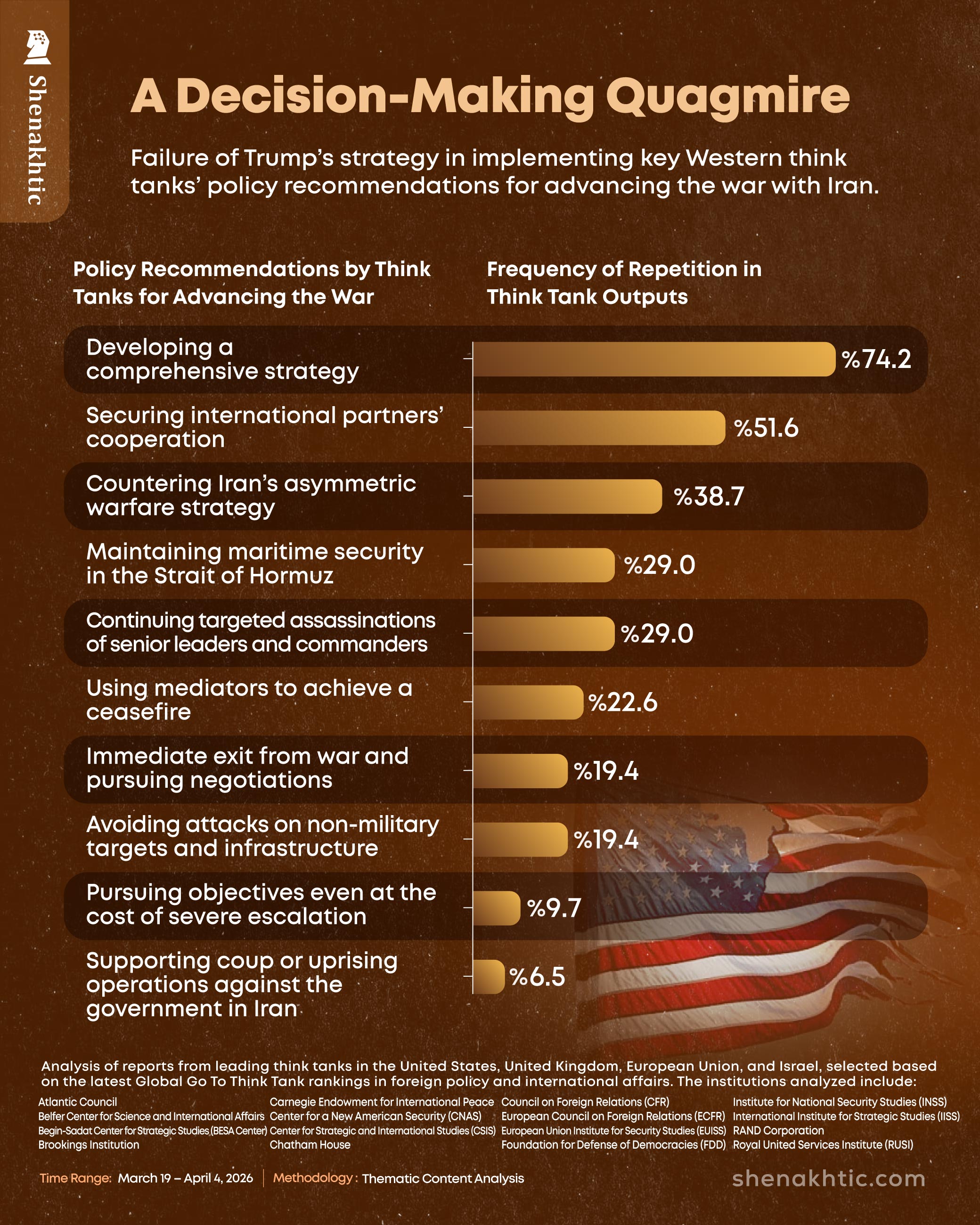
One of the key findings of this analysis is think tanks’ acknowledgment of the absence of a coherent strategy—both for entering the conflict, sustaining it, and defining the desired outcomes of a final agreement—under the Trump administration. More than 74% of the analyzed content highlighted this issue and called for clearly defined and publicly articulated end goals.
In other words, beyond public opinion, even the think tank community appears unconvinced and uncertain about why the war was initiated and what objectives it is ultimately meant to achieve. Assessing the appropriateness of strategies and the success of operations depends on first establishing this essential prerequisite.
Limited Success in Securing International Cooperation
More than 48% of the content considers the involvement of other countries in the confrontation with Iran necessary and encourages the U.S. government to build international cooperation—similar to coalition-building during the Iran sanctions campaign or the wars in Afghanistan and Iraq.
However, given developments in recent years—particularly Trump’s rhetoric and policies, which have weakened ties with traditional allies—and the global stakes of this conflict, many analyses recommend that even if allies cannot join a U.S.-led coalition, they should participate independently. This reflects the perceived difficulty Washington faces in mobilizing unified international backing.
Limited Emphasis on Regime Change Despite Support for Targeted Killings
More than 25% of the content references targeted assassinations of Iranian officials and commanders as an effective measure for weakening Iran and expresses support for such tactics. Despite this, only 6.5% call for operational U.S. military support aimed at regime change in Iran.
This suggests that internal political change in Iran is not a central priority for many think tanks; rather, targeted assassinations are viewed primarily as tactical tools within a broader military confrontation, not as part of a comprehensive regime-change strategy.
Although decisions by the current U.S. president may not always rely heavily on expert consultation, major security and military decisions involve other actors who are influenced by think tanks and their advisory outputs.
Data Source and Methodology
Our meta-analysis evaluated the latest policy recommendations for advancing the war with Iran. Data is synthesized from reports published between March 19 and April 4, 2026, by 16 leading global institutions: 9 U.S., 3 UK, 2 Israeli, and 2 European think tanks.